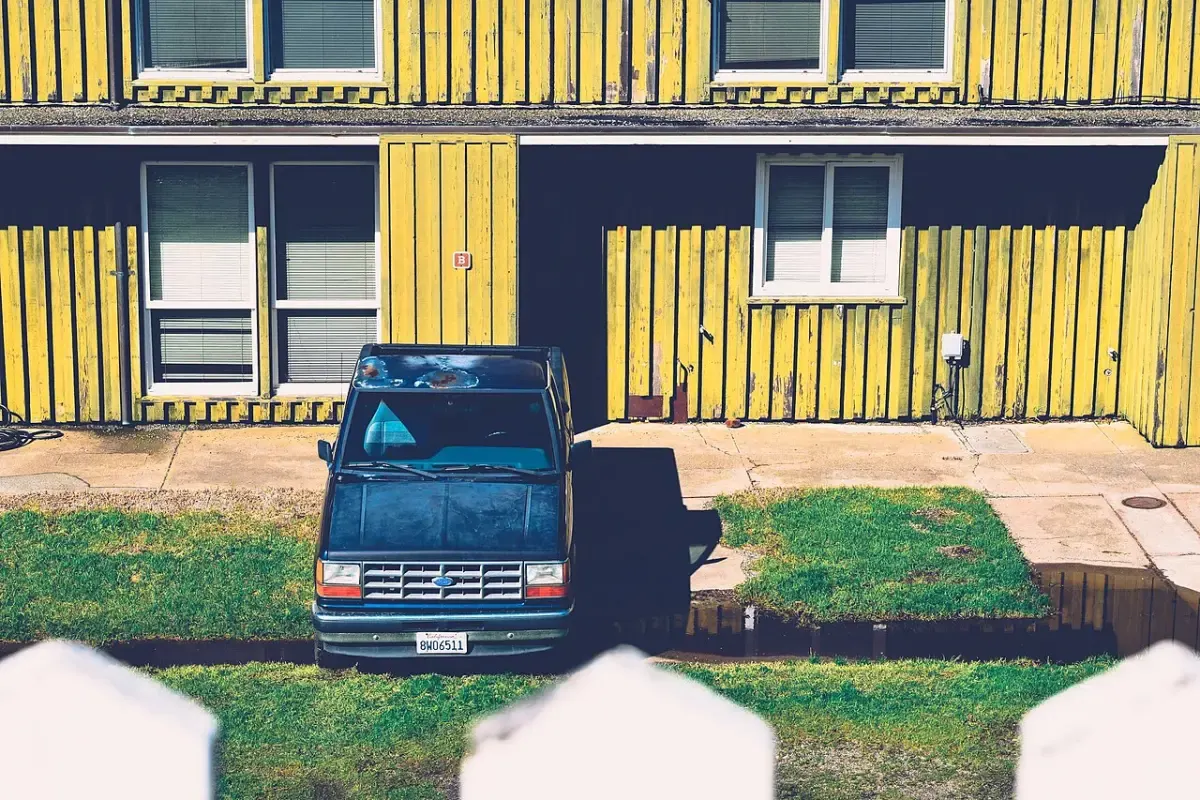
I was walking home the long way when I saw the truck. It was parked so squarely in front of the building, nose to the wall, that it looked like a toy someone had set down on a green felt table. The wall behind it was the colour of old mustard, with the paint peeling off in long vertical strips.
From the wrong side of the fence
There was a low white fence between me and the lot, and my first instinct was to find a gap in it. Then I noticed that the fence posts, pale and blunt against the grass, made a row of soft shapes along the bottom of the frame. I held the camera above them and let them blur. They act like a curtain being lifted, and they tell you that someone is looking from outside, without being invited.
I took one frame, moved a metre to the right, took another. The second is the one you see. The shadow of the truck falls to the right and meets the edge of a puddle, and the building is reflected in that puddle in a way I would never have arranged.
Colour that does not try
I used to photograph colour I had gone looking for: painted doors, market awnings, murals. This was different. Nobody had chosen this yellow for beauty. It was probably the cheapest paint available in a year when the building was repaired, and it has since weathered into something more interesting than anyone intended.
The truck is the opposite: dark, almost black, with a blue cast in the roof where the sky is reflected. Together they make a very simple colour scheme, and I find that restful.
The best colour is usually an accident of budget and weather. Arrive after the accident and take your time.
How I would look for it again
If you want to find a photograph like this one, these are the things I would suggest.
- Walk a route you already know, but at a different hour.
- Look for something that was parked, not placed. Cars, bicycles and ladders keep to the same spot for days.
- Find a foreground object to shoot past, whether it is a fence, a branch or a window frame.
- Leave before it gets dark, and come back the next day if the light was wrong.
There is also the matter of patience. A parked truck is a promise that nothing will happen for a while, and that gives you time to move around the scene and choose your spot. I find that more useful than any technique I have been taught.
I went back two days later. The truck had gone, and the lot looked ordinary. That is really the whole lesson of this letter: it was there for an afternoon, and I happened to be walking by.